Recently in Engineering class we have been studying principles and elements of an object. The object that I have chosen to describe is a table. It is a regular household item that people use daily.
Elements: Straigh lines, rectangular shapes, very geometric, spacious, smooth texture
Principles: balanced and symmetrical, the straight colored lines on the top create a smooth repeating rhythm, emphasis on the top with a different material (wood) and a different color
1) What is the TED organization about?
- It is a non-profit organization devoted to spreading ideas.
2) What is the purpose of their website and how does the functionality of their site support that?
-There purpose is to spread ideas or knowledge worth knowing. They have a series of videos to watch and discover.
3) As Engineers and Problem Solvers, which topic areas (the choices from the "Show talks related to:" section on the sidebar) are of most interest to us? Justify your answer.
-As problem solvers we should be interested in the design topic because being an engineer is all about design. Just like how are Iterative Design Process is related to engineering.
4) Based on your previous answer, what are 3 talks (videos) on the site that appear like they would be of most interest to you as an Engineer/Problem Solver? Justify your choices.
-Steve Jobs: How to Live Before You Die- Steve Jobs does a commencement speech for Stanford, he talks about how to design his
-John Hunter on the World Peace Game
-Yves Rossy: Fly with the Jetman
5) Each student will watch a unique video (clear your choice with me... first come, first served!). Watch the video. Embed the video in your blog post and create a bulletized outline of the key issues presented in the talk.
6) How could you get involved in the field/technology/issue you chose to hear about? What experience/skills/training/education would you need to learn to get involved with this field?
In the field that was shown, to go to Stanford I need to keep good grades and work hard. But how Steve Jobs operates, he followed what he loved which didnt mean a very intense education, he just stayed on a path that kept him happy. It might have been a struggle at sometims, but it worked for him.
For six days of May, I was fortunate enough to meet my Dad on the carrier he is currently stationed on. He has been working for 6 months on the USS Carl Vinson; it is a Naval Aircraft Carrier. Potentially every time a carrier comes back to its assigned base, many military workers push for a Tiger Cruise. A Tiger Cruise is when a military member is allowed the chance to bring family or friends on board the carrier for 6 days. During the week I was on the ship my task for engineering was to first, describe my Dads job on the ship, and secondly research three uses of technology on board.
Onboard the USS Carl Vinson my dad is the Chief of Staff for Carrier Strike Group 1. His job is to assist the Commander (the Strike Group Admiral), in development and execution of his Commander's Guidance. Meaning the Admiral is in charge of leading all his assigned ships, aircraft, and sailors into battle. My dad assists the admiral in ensuring the war plans are properally developed and attainable with the assets he has assigned. The military readiness and capability is not a for profit venture, however I witnessed several cost saving measures (reductions of operations, personnel, and units assigned). The approximate daily operations budget for the Strike Group is 3 to 5 million dollars. The risk involved with Carrier Strike Group Operations I feel is high, however military operations are inherently risky. Todays military employs several systems for risk mitigations, one of which is called Operational Risk Management. While onboard the Vinson I witnessed several examples of risk management (protective equipment, safety observers, quality assurance, reps, training, and intolerance to unnecessary exposure to risk).
First, I found three systems of technology that are very commonly used, the catapult system, the resting gear, and finally the anchors (catapult slack).
The resting gear is a major part of aircraft landing on the ship. It is the cable that the aircraft catches to be stopped on the carrier. The component that is inputed is the tailhook of a plane catching the cable to stop the plane. Instantaneously, hydrolic fluid is compressed in a piston below the flight deck. It is compressed from a 20 in cylinder to a 5 inch cylinder. The hydraulic force is able to contract the cable back to where it needs to be. The cycle is continious fromo kinetic to hydrolic to mechanical energy. This system takes approximately 21-22 seconds to complete. So on a regular Flight Ops day planes are catching the catapult every 40 seconds.
The second system I was informed about was the catapult. The catapult system is what launches the planes while on a carrier. It is much more complex than the resting gear. But the basics are similar to the resting gear, considering hydraulic fluid begins to flow then steam opens through an airflask sending the catapult forward. In fact the airflask consists of 2150 psi worth of air.
Lastly, is the anchor gear. This is not the same thing as the anchors that are dropped in the water. This gear has to do with the arresting gear. Since the pilots in the aircraft cannot land perfectly on the center of the cable everytime, the cable will have some slack in it. So the input is the tailhook of the aircraft reaching the cable, and the output is slack being taken out of the cable. Once the jet lands the system determines the amount of slack to take out, which could go out to about 20 feet. A piston is the sent through a shaft evening out the line.
We have just begun our Minecraft unit. This intertwines with our Architecture project because we were supposed to create a building that represents a few of the architects we researched. I represented Mies van der Rohe, Frank Llyod Wright and Tadao Ando. Mies van der Rohe allows a lot of light into his buildings, i used large glass windows. Frank Llyod Wright uses overhangs on his buildings mine goes over the water. Finally, Tadao Ando uses concrete, the base of each of my floors has concrete as a floor.
We are just about to begin our Architecture Project. This is the start of, finding architects we are interested in.
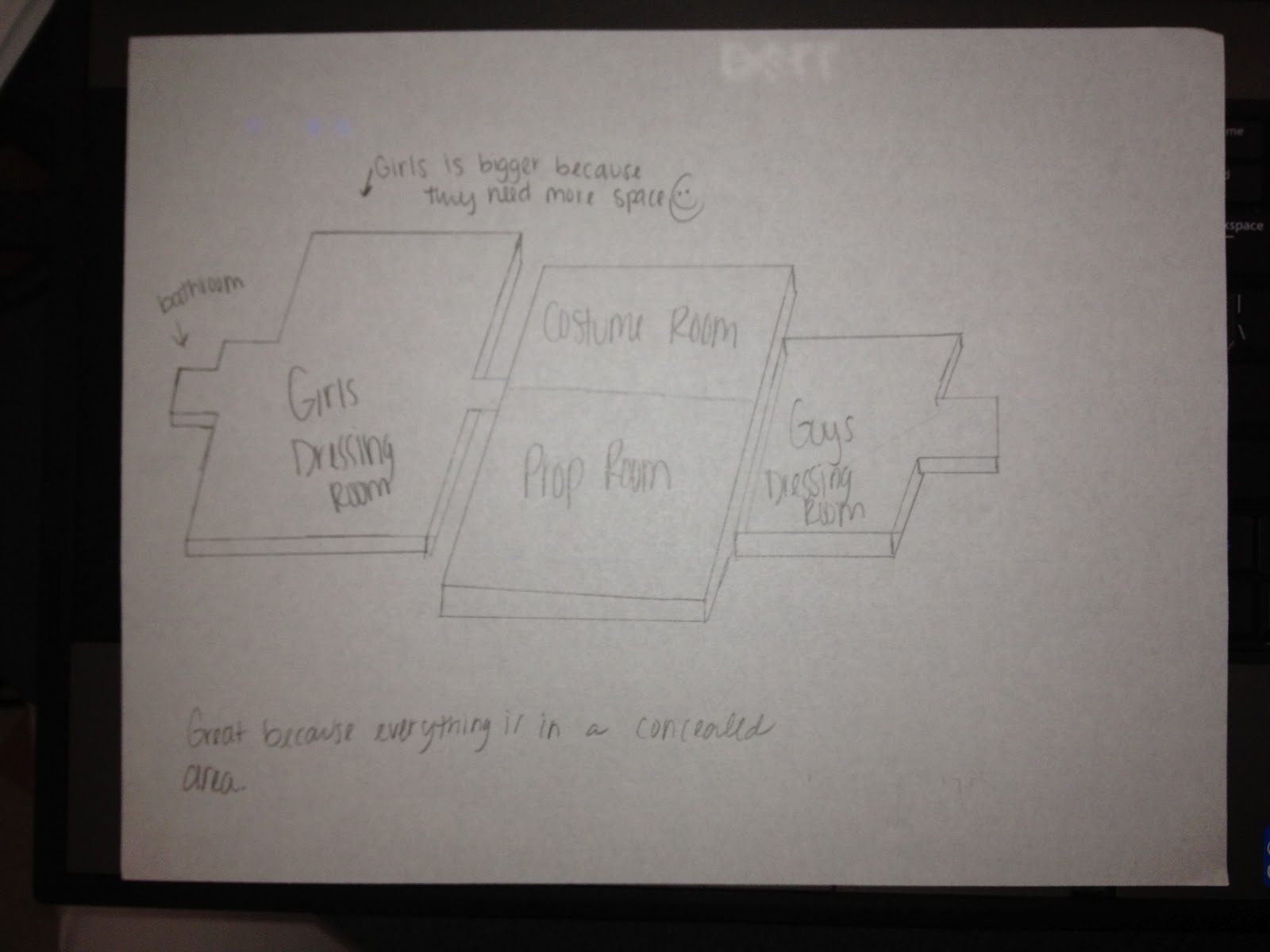
When starting our sketches and process of choosing how we should desing the prop room and costume room. Sean used his knowledge with MineCraft and did the design he felt would the best. Then we worked backwards to design other sketches and the CAD for other designs.
Our Sketches
This is probably the most simplest idea. It just has a wall seperating the big props and the small props. The down side is it would be hard to move around in there.
This prop room was designed off of the UCLA room. Shana was aware that at UCLA their prop room was two stories. The 2nd floor having the small props which are easy to take up and down stairs. And the larger props on the bottom which might be a little harder to move.
This prop room was Sean's Idea. He like how the Prop, Costume Room, and Dressing Rooms, were close together so they are easy to access. The Girls' dressing room is noticeably bigger because Sean thought girls needed more room to dress... :)
Minecraft Design
CAD Design
We heard back from our client and they gave us some feedback that was ideal to complete this project.
+: They enjoyed how the are was very spacious, also they liked how the girls dressing room was setup.
Change: the client would change the accessibility to the costume and the prop room, and a little more room for the bigger props
?: Why are all the rooms connected?
!: They emphasised on a ramp for bigger items
Today in class we have started the Annual Egg Drop Challenge! So far we have completed 22 Achievements
Brainstorm
Cup in which the egg will go into
Egg holder without the balloons
Calculations
- We figured that our contraption with the egg was 55.8 grams, and the egg alone was 47.2 grams. Subtracting the two would equal 8.6 grams. So the contraption alone weighed 8.6 grams.
Achievements
Brainstorming
-Create a sketch of one possible solution. Include labels.
-Create a sketch of another possible solution. Include labels. -Create a sketch of a third possible solution. Include labels. Material Prep: -Generate a list of materials required for build day. -Document a plan to ensure materials are brought in on block day. Material Weight: -Your materials weigh less than 500 grams. -Your materials weigh less than 300 grams. -Your materials weigh less than 200 grams. -Your materials weigh less than 150 grams. -Your materials weigh less than 100 grams. -Your materials weigh less than 50 grams. -Your materials weigh less than 25 grams. Drop Accuracy: -You hit the butcher paper! -You hit inside the third ring! -You hit inside the second ring! Drop Time: -Your solution takes more than 2 seconds to hit the target! Egg Resilience: -Your egg didn't break in any way! (awarded three times) -Your egg didn't break in any way! (awarded three times) -Your egg didn't break in any way! (awarded three times) Calculation Achievements -Describe an aspect of the event using arithmetic.
-Describe an aspect of the event using geometry.
-Describe an aspect of the event using algebra.